Air & health · Evidence explained
From lungs to heart and brain: understanding long-term air-pollution risks
Air pollution matters beyond the airways. Cardiovascular evidence is stronger, while cognitive and dementia research retains important uncertainties. Separate scientific findings from practical household measures.
Cardiovascular evidence is substantial, but does not predict an individual fate
PM2.5 is a mixture of small particles and droplets that can reach deep into the lungs. WHO identifies ischaemic heart disease and stroke as major parts of the health burden from outdoor air pollution. EPA explains that particle pollution can worsen existing cardiovascular disease and contribute to its development. Heart and vascular health belong in the discussion of air exposure.
High short-term exposures are linked with increased cardiovascular events, and long-term exposure with higher cardiovascular mortality. Population-level risk does not mean one exposure inevitably causes one event. Age, blood pressure, cholesterol, smoking and existing disease remain important. Regional statistics cannot yield a person’s certain outcome, and a filter-removal percentage cannot be converted into a disease-prevention percentage.
Families cannot shoulder all pollution control. WHO notes that many outdoor sources require transport, energy, industry and urban policy measures. Homes account for only some exposure; work, commuting and outdoor environments matter too. Improving indoor air does not remove the need for public environmental action.
Lung responses can affect vessels and heart regulation
Studied pathways include inflammation extending beyond the lungs, oxidative stress and changes in autonomic regulation. Oxidative stress involves imbalance between generation and control of reactive molecules. These responses can affect vascular lining, clotting and cardiac electrical activity. The autonomic nervous system helps regulate heart rate and vascular tone. These interconnected pathways are more accurate than the idea that particles simply clog blood vessels like sediment.
Research also examines entry of some ultrafine particles or soluble components into circulation. It does not show that every inhaled PM2.5 particle enters blood or brain. Evidence comes from different experimental and population studies, and mechanisms continue to be refined. They help explain risk, not establish that one person’s symptoms must be pollution-related or that a domestic system has therapeutic effects.
Cognitive health: an observed association with important limits
A US cohort study published in JAMA Internal Medicine in 2023 included 27,857 adults aged 50 or over without dementia at baseline, with approximately 10.2 years’ average follow-up. It modelled long-term residential PM2.5 exposure and classified outcomes using cognitive testing and proxy reports. Higher exposure was associated with more incident dementia; associations varied by emission source.
This was observational, not random assignment to pollution levels. Residential estimates are not individual inhaled doses; education, socioeconomic conditions, behaviour and co-pollutants can affect interpretation. Adjustment cannot exclude all residual confounding. Vascular injury may connect cardiovascular and brain health, while other inflammatory and neural pathways remain under investigation. The study does not show that formaldehyde or a CO₂ spike causes Alzheimer’s disease, or that household filtration prevents dementia.
Different pollutants need different controls
Source control + air exchange
Formaldehyde · TVOC · CO₂ · odours
Reduce indoor emissions and design mechanical ventilation around outdoor conditions and occupancy.
Filtration + clean-air delivery
PM2.5 · pollen · microbe-carrying aerosols
Match filter efficiency, sealing and delivered airflow to reduce airborne particle exposure.
Cleaning + moisture control
Settled dust · mite and allergen reservoirs
Remove dust with central vacuuming, route exhaust outdoors appropriately, and manage fabrics and moisture.
Monitoring + coordinated control
Temperature · humidity · air trends
Adjust equipment to measurements and use patterns; check sensor limitations and maintenance.
Separate gases from particles and reduce sources first
Outdoor PM2.5 research cannot simply be applied to every indoor pollutant. Formaldehyde and other VOCs need assessment of their sources, chemistry and exposure. TVOC does not establish the danger of each component. Reduce tobacco smoke, emissions from materials and chemical products, and use appropriate local kitchen extraction. Hiding an odour does not remove the pollutant.
Mechanical ventilation dilutes indoor-generated formaldehyde, VOCs, CO₂ and some odours through air exchange. Outcomes depend on emission strength, outdoor conditions and delivered ventilation. CO₂ offers clues about occupancy and air exchange, not oxygen concentration or every air risk. During outdoor smoke episodes, consider intake filtration and operating strategies instead of opening windows indiscriminately.
Filtration, dust removal and moisture management have separate tasks
Particle filtration requires sufficient airflow and running time. Whole-home performance also requires professional checks of unit and filter sealing, room airflow and maintenance. A media grade alone is insufficient. Lower indoor particle concentration is an environmental outcome that can be checked; it is not automatically a reduction in heart attacks or dementia. Recirculating filtration does not replace necessary outdoor air.
Settled dust needs vacuuming, damp wiping and bedding care. Where central vacuuming exhausts outdoors, verify the outlet location and sealing so emissions are not drawn back into an intake. Removing some mite allergens is not permanent mite eradication. Repair leaks and condensation before relying on dehumidification; avoid excessive humidification and maintain hygiene. Comfort and cleanliness have practical value but are not heart or brain treatment.
Filters require inspection and replacement. Verify that the system can still provide the required air at its everyday setting. Record replacement dates, running times and indoor trends to identify maintenance gaps. Even a clear improvement in one environmental measurement demonstrates that environmental change, not a proven long-term clinical outcome.
Make long-term goals checkable in daily life
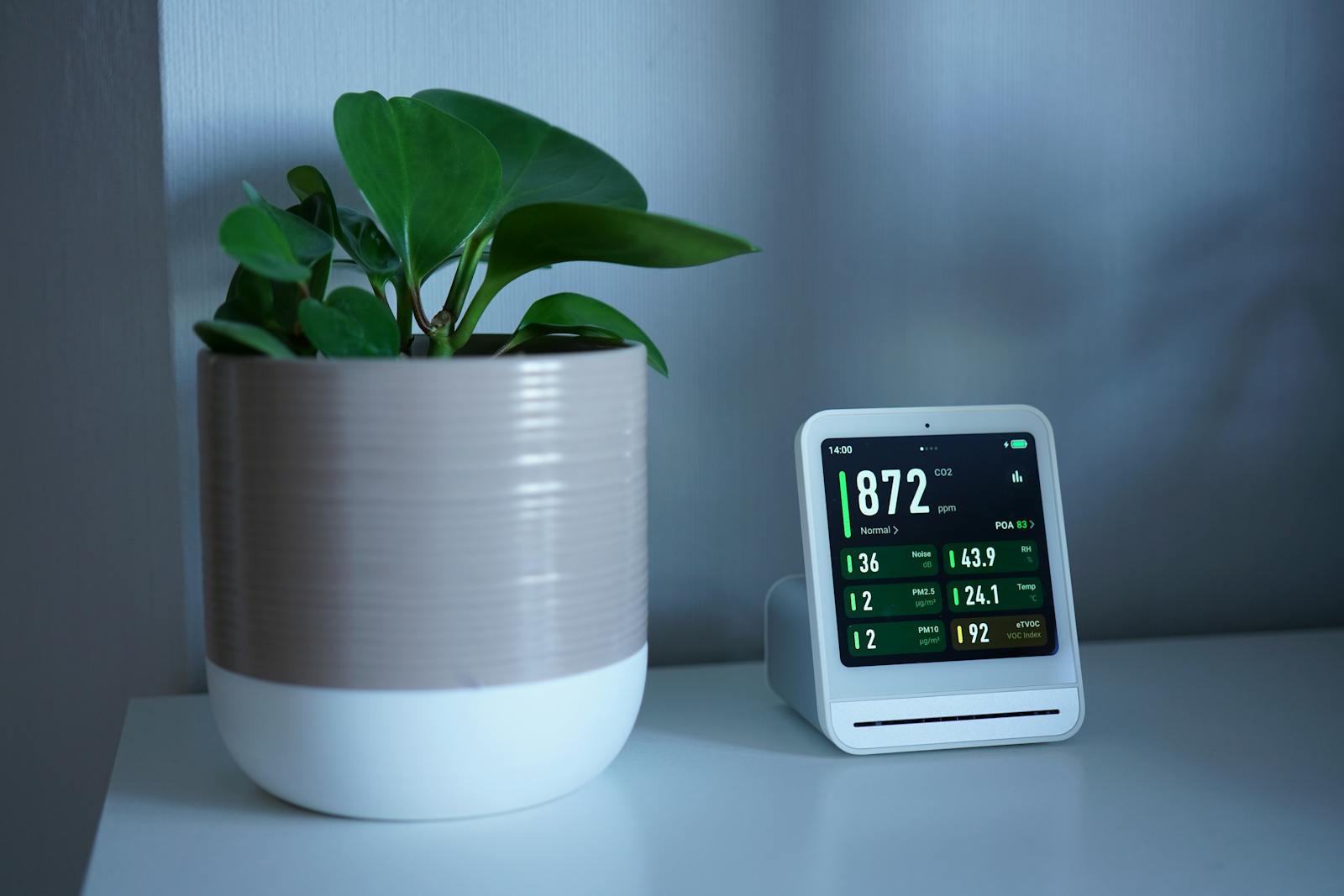
Begin with a week of observations: outdoor conditions, cooking and cleaning, and PM2.5, CO₂ and humidity trends. Review whether source reduction, ventilation or filtration changes the pattern. Place sensors as instructed rather than measuring only next to an outlet. Persistent formaldehyde or TVOC abnormalities, or inconsistent readings, call for sensor verification and appropriate professional testing, not just attention to display colour.
Reliable monitoring and coordinated controls can help manage ventilation, dehumidification, humidification and cooling, with maintenance, human review and abnormal-condition handling. During poor outdoor air, consider changing activity time, route or intensity instead of abandoning activity indefinitely. People with cardiovascular disease should continue their clinical management of blood pressure, lipids and other factors. Household measures aim to reduce controllable exposure and improve the living environment.
References & original sources
- Ambient (outdoor) air pollution
World Health Organization (WHO) · 2024
- Air Pollution and Cardiovascular Disease Basics
U.S. Environmental Protection Agency (EPA) · 2026
- Particle Pollution and Cardiovascular Effects
U.S. Environmental Protection Agency (EPA) · 2026
- Particle Pollution Exposure
U.S. Environmental Protection Agency (EPA) · 2026
- Comparison of Particulate Air Pollution From Different Emission Sources and Incident Dementia in the US
University of Michigan and collaborators; JAMA Internal Medicine (indexed by the U.S. National Library of Medicine) · 2023
- Improving Indoor Air Quality
U.S. Environmental Protection Agency (EPA) · 2026
- Volatile Organic Compounds' Impact on Indoor Air Quality
U.S. Environmental Protection Agency (EPA) · 2026
- What should I know about formaldehyde and indoor air quality?
U.S. Environmental Protection Agency (EPA) · 2026
- Low–Cost Air Pollution Monitors and Indoor Air Quality
U.S. Environmental Protection Agency (EPA) · 2025
- Guide to Air Cleaners in the Home
U.S. Environmental Protection Agency (EPA) · 2018
- Air Cleaners and Air Filters in the Home
U.S. Environmental Protection Agency (EPA) · 2026
- Sources of Indoor Particulate Matter (PM)
U.S. Environmental Protection Agency (EPA) · 2026
- Care for Your Air: A Guide to Indoor Air Quality
U.S. Environmental Protection Agency (EPA) · 2026
- Personal protection and public policy change can decrease health impact of air pollution
American Heart Association (AHA) · 2020