Air & health · Evidence explained
Formaldehyde and TVOC: comparing ventilation, sprays and air cleaners
Identify the source before comparing treatments. Emission reduction, mechanical ventilation, particle filtration and gas sorption have different roles. Verify coverage, useful life and cost under realistic conditions.
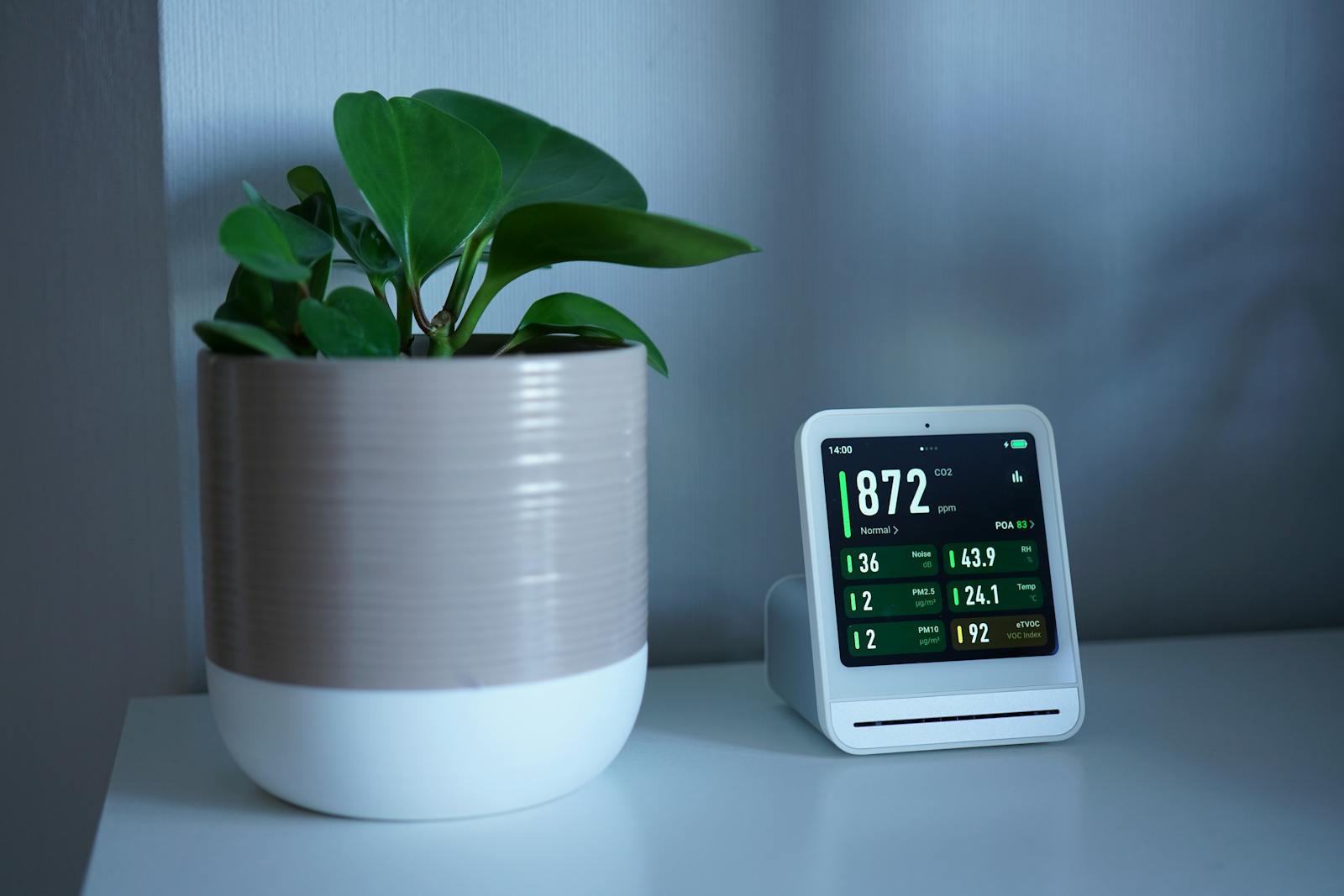
Distinguish formaldehyde, TVOC, CO₂ and odours
Formaldehyde is a specific compound, with sources including some engineered wood, furniture, adhesives and other products. TVOC is a combined measurement of diverse volatile organic compounds, not a substance with one toxicity. EPA notes that a lower total does not necessarily mean lower toxicity because composition differs. Investigate formaldehyde specifically, and identify other target gases when they are suspected.
Odour can help locate a source but is not a direct measure of exposure risk. CO₂ commonly reflects occupancy and ventilation, and does not replace formaldehyde or VOC testing. Ordinary particle filters are not household CO₂-removal systems. Before comparing controls, identify whether the concern is continuing material emissions, a cleaning event, insufficient ventilation during occupancy, or several issues together.
Keep records of the room, sampling time, temperature, humidity, window and door state, and activities. Comparing a reading after airing with one during closed-door sleep may not reveal what caused the change. Gas trends matter, but one low reading does not guarantee long-term conditions, and one sensor’s green display does not establish complete air safety.
Reduce continuing emissions: the starting point for every approach
EPA identifies reducing or removing sources as a key air-quality measure. For materials and furniture, review relevant emission tests, avoid unnecessary quantities and replace problematic materials where necessary. Use, seal and store cleaners, paints and solvents as labelled, with appropriate local extraction. Reducing combustion smoke and unnecessary fragrance is source management that does not always require more equipment.
The WHO formaldehyde chapter describes emissions from some new materials and products continuing over time, affected by temperature, humidity and air exchange. This does not give every piece of furniture the same emission rate or establish that a fixed number of days makes it safe. While sources keep emitting, controls face a continuing load. Review actual use after brief airing or a one-off treatment.
Distinguish a temporary fall in room concentration from reduced material emissions. Access to a furniture surface does not prove that its interior, back or joints have been treated. That is a reason to check treatment coverage, not evidence that every treatment fails. Combine sources that cannot be removed with ventilation and any justified targeted cleaning, and plan subsequent verification.
Mechanical ventilation exchanges and dilutes air, under defined conditions
Mechanical ventilation removes indoor air and supplies outdoor air. Local extraction can capture pollution near an activity; whole-home ventilation distributes air exchange between rooms. Cooling or increasing recirculation does not automatically supply outdoor air. Consider sources, use, delivered supply and extract, and pressure relationships rather than assuming the unit’s rated airflow describes every room.
A simplified mass balance illustrates the limitation. In a well-mixed room with constant emissions and ventilation, neglecting other removal and sorption, steady-state indoor concentration is approximately outdoor concentration plus emission rate G divided by effective outdoor-airflow Q. G in mg/h and Q in m³/h give concentration in mg/m³. This illustrates a mechanism rather than replacing design calculations, and explains why continuing emissions or outdoor pollutants rule out a promise of zero gas. For airflow stated in CFM, multiply by approximately 1.699 to obtain m³/h before using this SI equation.
Assess outdoor air too. Particle filtration treats incoming particles, not automatically every outdoor gas. Nearby exhausts, traffic and smoke influence intake design. Verify room airflow and supply/extract paths, including closed windows and quiet night operation. Ventilation has a continuing role; an air cleaner can provide supplementary treatment. These approaches can work together.
Different pollutants need different controls
Source control + air exchange
Formaldehyde · TVOC · CO₂ · odours
Reduce indoor emissions and design mechanical ventilation around outdoor conditions and occupancy.
Filtration + clean-air delivery
PM2.5 · pollen · microbe-carrying aerosols
Match filter efficiency, sealing and delivered airflow to reduce airborne particle exposure.
Cleaning + moisture control
Settled dust · mite and allergen reservoirs
Remove dust with central vacuuming, route exhaust outdoors appropriately, and manage fabrics and moisture.
Monitoring + coordinated control
Temperature · humidity · air trends
Adjust equipment to measurements and use patterns; check sensor limitations and maintenance.
What each control method addresses
| Method | Gases and CO₂ | Coverage | Consumables and upkeep | What to verify |
|---|---|---|---|---|
| Source control | Reduces emissions; does not replace occupancy ventilation | Depends on identified and treated sources | Material replacement, correct use and emission verification | Missed sources; one temporary reduction is not lasting source control |
| Chemical sprays, gels or coatings | Verify the formulation, mechanism and target; do not assume CO₂ removal | Depends on application, quantity and air contact | Dosage, useful life, reapplication and retesting | Ingredients, residues, by-products and conditions; no blanket conclusion |
| Ordinary particle cleaner | Particle media alone do not establish HCHO, TVOC or CO₂ control | Focus on the room air path and usable fan setting | Particle filters, clear air paths and ongoing operation | Particle CADR or room area mistaken for gas or whole-home performance |
| Cleaner with gas-treatment media | Target-specific, finite capacity; not ordinary CO₂ treatment | Affected by position, doors, mixing and use | Replace and verify according to loading and product evidence | Wrong target, breakthrough or unverified by-products |
| Mechanical ventilation and local extraction | Exchanges and dilutes with outdoor air; depends on emissions and effective airflow | Designed distribution and room-by-room checks | Filters, terminals, heat exchange, drainage and energy | Outdoor pollution and poor distribution; no zero-gas promise |
Assess sprays, gels and coatings by their formulation and intended use
“Formaldehyde remover” describes a marketed purpose, not ingredients, mechanism or lasting performance. A spray may claim a reaction, a coating reduced material emissions, and a gel or passive material adsorption. Similar names do not demonstrate equal performance, and unspecified formulas should not all be declared harmful. Ask what is treated, where, how it was tested and how long the effect lasts.
A sealing or emission-reduction claim needs comparison with untreated material and information on substrate, application quantity, coverage, durability and retesting. Air-reaction or sorption claims need target gases, dosage and capacity. These are questions for verifying claims, not conclusions about an untested formula’s efficacy or risks. Masking odour with fragrance does not demonstrate removal of formaldehyde or other VOCs.
Review ingredients and safe-use information, including contact and inhalation exposure, precautions around children and pets, surface suitability and ventilation after application. FTC cautions that “non-toxic” claims and certification graphics need specific support. Household products can themselves release VOCs, so assess added substances and possible reaction products. Where data are missing, state the gap instead of treating marketing as verification.
Particle-cleaner performance is not evidence of gas removal
HEPA and similar particle media capture particles carried through them. Formaldehyde, other VOCs and CO₂ are gases; a particle-filter grade alone does not establish control. Even a high particle clean-air delivery rate needs separate evidence about gas-treatment media and whole-unit performance under relevant conditions. A fan does not mean outdoor-air ventilation, and a particle filter does not mean comprehensive formaldehyde control.
EPA’s consumer guide explains that particle CADR rates particle treatment, not gas removal. It often relates to higher fan settings; review everyday performance if noise leads to a lower setting. Appropriate recirculating filtration still has value for smoke, pollen and indoor particles. Its inability to replace ventilation does not invalidate the job it is intended to do.
Consider room volume, air paths and running time, keep intakes and outlets clear, and replace filters as instructed. If formaldehyde is the concern, ask specifically for gas performance evidence. If bedroom CO₂ rises overnight, check outdoor-air supply. Clarifying the target helps avoid buying a capable particle appliance for an unverified gas-control task.
Gas-treatment media have finite capacity
Activated carbon and other gas media can provide targeted control, but need to suit the compound. EPA’s technical summary describes finite sorption capacity and dependence on gas identity, concentration, competing gases, airflow, media quantity, temperature and humidity. Ordinary activated carbon has particular limitations for low-molecular-weight aldehydes such as formaldehyde. Specialist or modified media use different mechanisms and still need relevant test evidence; “contains carbon” is insufficient.
As loading increases, media can approach saturation. Rising outlet concentration may indicate breakthrough. Initial removal efficiency, total capacity and maintenance interval are different measures. A thin layer may lose usefulness relatively quickly; examine media quantity, operating conditions and replacement criteria. These limitations do not imply immediate failure of every product, but performance management must extend beyond installation of fresh media.
Ask specific questions: Was formaldehyde tested separately? At what humidity and concentration? For how long? How is performance checked after use? Are replacement media reliably supplied? Do not automatically use a particle-filter schedule for gas media or apply one compound’s capacity to all VOCs. Separate layers in the same appliance may need separate maintenance.
Whole-home coverage needs effective paths between rooms
An air cleaner in the living room does not establish that gases in a closed bedroom reach it promptly. NIST’s multizone field study used decane to examine cleaner location, source location, door state and air mixing. It shows that these conditions affect spatial performance, not that every modern cleaner or VOC behaves identically, and does not rank specific brands.
Check room by room: where are sources, are doors closed during sleep, and does the actual setting bring that air into the treatment path? Furniture obstructing flow, or treated air quickly returning to an intake, can limit treatment farther away. This is a conditional airflow problem, not proof that every purifier short-circuits. Central ventilation also needs to avoid premature extraction of supply air and verify terminal distribution.
Compare living-room and bedroom trends under comparable use, recording placement and settings. If one improves and another does not, investigate sources and flow before simply increasing total power. Local portable cleaning, whole-home ventilation and gas-media treatment can be combined. A whole-home claim needs room coverage and real measurements to support it.
Check added pollution as well as removal
Active oxidation, plasma and some photochemical approaches require evaluation of by-products alongside target reduction. In 2025 NIST described standardised by-product testing addressing ozone, formaldehyde and ultrafine particles. Evaluation should therefore include more than one removal percentage. This does not imply that every active technology, spray or model creates the same risk.
EPA advises against ozone generators sold as air cleaners in occupied spaces. Ozone can irritate the respiratory system and react with indoor chemicals to form other irritants. It is not the oxygen people need to breathe. Fading odour does not prove reaction products are safe. Check emissions and use conditions for the particular equipment and operating setting.
Chemical treatments likewise need assessment of ingredients, residues and the resulting air. Words such as “plant-based”, “natural” or “breaks down into water” do not establish safety by themselves. Requesting removal evidence and added-emission data is a fair verification approach. Mechanical ventilation also needs checks of intake pollution, installation materials and maintenance. Every approach should disclose relevant conditions.
Compare lifecycle cost on equivalent coverage and operating goals
Align room coverage, running time, target pollutant and maintenance before comparing costs. A one-room cleaner cannot be compared with a multi-room ventilation system by purchase price alone; ventilation costs also include installation and conditioning incoming air. Include quantity, reapplication, labour and retesting for sprays or gels rather than comparing only one container’s price. Without shared assumptions, value is difficult to judge.
A transparent framework is annual cost equals annualised equipment and installation plus electricity, consumables, maintenance and verification, and additional costs of heating or cooling incoming air. Electricity cost equals actual input power in watts multiplied by annual running hours, divided by 1,000, multiplied by the local price per kWh. Calculate separate settings where power differs. Assess heating or cooling loads by climate and heat recovery without double-counting electricity. This is a method, not a quotation.
Gas-media replacement should reflect pollutant loading and stated conditions, not visible dirt alone. Ventilation needs upkeep of filters, intakes, outlets, heat-exchange components and drainage. Heat or energy recovery can reduce some conditioning loads but is not zero energy and has equipment and maintenance costs. Request a justified consumables schedule and use local prices; no route is always cheaper.
Build a verifiable long-term control and acceptance process
Check the target pollutant, initial concentration, chamber or room volume, temperature, humidity, dosage or setting, duration and control conditions in a report. Distinguish single-pass removal, chamber concentration reduction, material emission reduction and actual room concentration: they answer different questions. Check the scope of any test standard. Particle performance, energy labels or an institution’s name do not establish every gas claim.
Chambers compare defined conditions; homes contain continuing sources, doors, furniture and distributed airflow. Verification can combine source records, terminal airflow checks, room measurements and later reassessment. Occupancy or specific exposure decisions need methods appropriate to the compound and local requirements. Consumer HCHO or TVOC indicators help reveal changes but cannot replace these processes alone.
Use an actionable combination: reduce emissions, maintain suitable ventilation, filter particles, add verified gas media when needed, and coordinate temperature, humidity and maintenance. Review occupancy and ventilation when CO₂ changes; revisit materials and activities when gases remain abnormal. Normal CO₂ does not rule out emissions. The goal is reduced controllable exposure, not permanent compliance after one treatment, disease therapy or zero risk.
References & original sources
- WHO Guidelines for Indoor Air Quality: Selected Pollutants — Chapter 3, Formaldehyde
World Health Organization (WHO) · 2010
- What should I know about formaldehyde and indoor air quality?
U.S. Environmental Protection Agency (EPA) · 2026
- Volatile Organic Compounds' Impact on Indoor Air Quality
U.S. Environmental Protection Agency (EPA) · 2026
- Does EPA regulate volatile organic compounds (VOCs) in household products?
U.S. Environmental Protection Agency (EPA) · 2026
- Low–Cost Air Pollution Monitors and Indoor Air Quality
U.S. Environmental Protection Agency (EPA) · 2025
- Improving Indoor Air Quality
U.S. Environmental Protection Agency (EPA) · 2026
- Guide to Air Cleaners in the Home
U.S. Environmental Protection Agency (EPA) · 2018
- Residential Air Cleaners: A Technical Summary, Third Edition
U.S. Environmental Protection Agency (EPA) · 2018
- Ventilation FAQs
Centers for Disease Control and Prevention, National Institute for Occupational Safety and Health (CDC/NIOSH) · 2024
- Development of a Field Test Method to Measure Gaseous Air Cleaner Performance in a Multizone Building
National Institute of Standards and Technology (NIST) · 2007
- Some Air Cleaners Release Harmful By-Products. Now We Have a Way to Measure Them.
National Institute of Standards and Technology (NIST) · 2025
- Ozone Generators that are Sold as Air Cleaners
U.S. Environmental Protection Agency (EPA) · 2026
- Eco-Friendly and Green Marketing Claims
Federal Trade Commission (FTC) · 2021
- Ventilation and the indoor environment
Health Canada · 2018
- Consumer Guide to Home Ventilation
U.S. Department of Energy (DOE) · 2021